
Despite outward appearances—the red hair, the invisible eyebrows, the solid construction—my mother and I are very different creatures. I’m an introvert; she’s an extrovert. I work with words; she’s best with numbers. We clashed throughout my teens, and we still struggle to understand each other to this day.
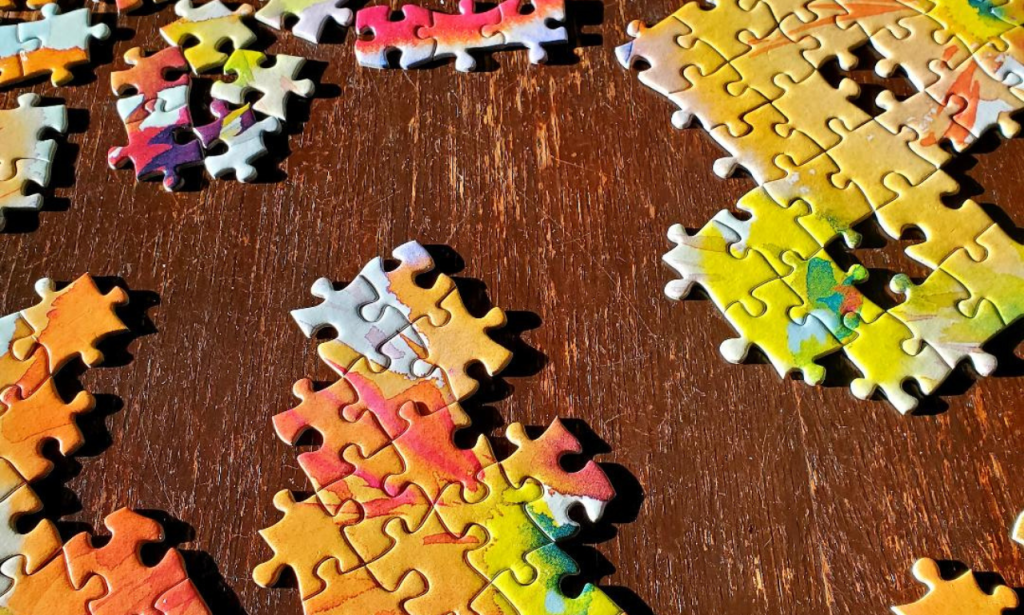
But one thing we have in common is that we are puzzle people. Jigsaw puzzles, that is.
I remember working on jigsaw puzzles with my mom when I was young, with the most intense puzzling done at Christmas time. We would both plant ourselves at the big dining room table, fortified by pulla and coffee, and work away until it was time for sauna and dinner. The puzzle would be carefully covered up with the white tablecloth and red runner, only to be uncovered again after dinner was done.
Things haven’t changed. Both my mom and I always have a puzzle on the go, and we can be relied on to trade finished puzzles and gift each other new ones.
This past Christmas, my mom and I were working on a new puzzle together, and that’s when I noticed our different puzzling styles.
When I work on a puzzle, I start with the edges first. I shake and sift and root around until I have all the edge pieces in place. From there, I select the most distinctive patterns or colours to start with, like all the reds or pinks, or all the pieces with zebra stripes. I dread the sections of the puzzle made up of solidly coloured sky or water.
My mother takes a different approach. She shakes out big handfuls of puzzle pieces, fastidiously laying them out right-side up and grouping similar colours or patterns together. She will start with the dreaded expanses of sky, snapping the pieces into place, making a little happy sound each time. If she doesn’t have all the edge pieces, it doesn’t bother her—she just keeps going, working her way horizontally and methodically across the puzzle.
My mom starts at the beginning and goes on until she’s done. I need an outline and a box to play in first, and then I get pulled along by bright colours and whatever draws my eye.
This is a true parallel to my writing style.
When I start writing something new, I generally have an idea of the setting, the edge pieces of the story. My stories tend to take place in very defined spaces—like this one set a restaurant or this one in a walk-in closet. With that setting in place, I can move towards the already-imagined end, fleshing out the bright, flashy moments of conflict or emotion first, before filling in the spaces in between.
My fellow Restless Writer Andrea shared this Writer Unboxed post by Densie Webb, who talked about being a “discovery writer.” That’s me to a T. I discover the story as I write it. I know other writers who develop intricate outlines, and write tens of thousands of words just in the planning stage.
Whatever approach works for you—in jigsaw puzzles or in your writing—lean into it. There’s nothing wrong with experimenting with new methods or techniques. That’s how we evolve in our creative lives. But if something feels natural to you and keeps your writing synapses firing, you don’t have to change a thing.
Looking for more weekly-ish writing inspiration? Subscribe to my newsletter, Petits écrits / Tiny writings, here.
 Maria Hypponen