
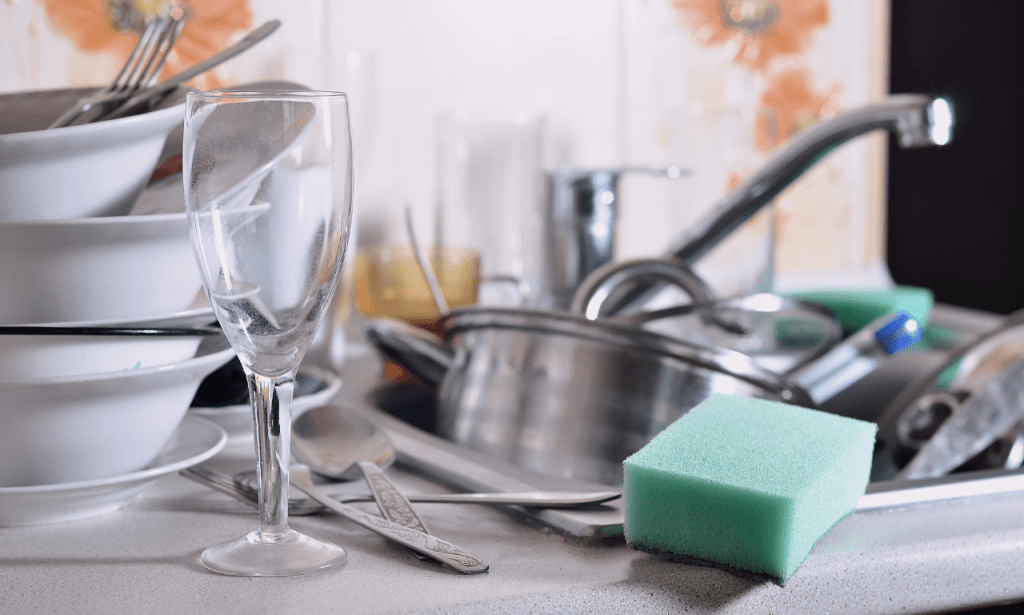
A few years ago, I moved across the country to a new home in a new city. We didn’t have a dishwashing machine right away. I grumbled a bit at first, but eventually took on the role of Dishwasher-in-Chief. (It was only fair—my husband is a far superior cook.)
Despite the chapped hands and time spent elbow-deep in icky water, I found hand-washing the dishes to be meditative and satisfying. It gave me a sense of accomplishment, and helped me start or finish my day on a squeaky-clean note.
It also came in handy as an excuse not to write. How easy it was to turn to the sink instead of my work in progress! The dishes have to get done, I thought. I’ll write once everything is clean and put away.
When the dishwasher was finally installed, I should have been pleased to have all my creative time back, right? I was, but I still found myself mindlessly puttering in the kitchen once the dishwasher had been filled or emptied, as if I was looking for more dishes to do.
One day, while cleaning an already-clean kitchen sink, I had a minor a-ha moment. I had duped myself into thinking that doing the dishes—or doing anything, in fact—was more pressing than writing. Despite thinking I was a pretty disciplined person, I had slipped up and let my distractions get the better of me.
Recognizing this, I gave myself a little mental face-palm, stepped away from the sink, and powered up my laptop.
There are still some days where I would much rather scrub the bathtub than write. Some days, I tell myself that it is absolutely critical that I use the Magic Eraser on those baseboard scuff-marks right away. As a writer, I am not proud of those days. As a regular human person, I am still vulnerable to them. I bet you are too. Life and chores still need to be taken care of. But you need to be able to tell when your to-do list becomes a distraction.
How do I tame those domestic distractions? Here’s my approach:
- I show up where the writing happens. I kept telling myself that I was “writing in my head” while I was doing all those dishes. While it’s true that our brains do plenty of creative work when we’re doing manual labour, you eventually have to get those ideas out of your head. It was only after I got my butt in my chair that I was able to ignore the pull of that particular distraction and put one word after another.
- I identify what I what to accomplish. I pick a word-count goal, a scene, an outline, or a character study—whatever I think I can reasonably accomplish in the time I have set aside. If I achieve that goal, I can allow myself to take a break and complete a satisfying household chore. Or I can let the momentum carry me further with my writing.
- I write down my priorities. If I have three things to work on, I prioritize them in a way that works for me and write them out on my whiteboard. That way, I can literally see what I have to do. This helps me size up my creative tasks against vacuuming the basement carpet. I don’t wallow if I don’t finish everything on the list. That just leaves me with an easy starting-point for the next day.
- I recognize my fears and barriers. I try to clock when something is making it oh-so-easy to focus on household chores instead of my writing. I take a moment to reflect on what is keeping me from writing the next sentence or the next scene, or powering through a final proofread before submission. Am I blocked? Facing an unworkable plot point? Afraid of sending my writing out into the world? Those barriers are pretty tough. But I know my impulse to write is just as strong.
The dirty dishes, the gross bathtub, the acres of laundry, the grimy windows—those things will never go away. But time will. More quickly than we can imagine.
What will you regret more at the end of the day? That you didn’t finish the dishes? Or that you didn’t write the story that only you can tell?
Write first. The dishes will still be there when you’re done.
Looking for more weekly-ish writing inspiration? Subscribe to my newsletter, Petits écrits / Tiny writings, here.
 Maria Hypponen