
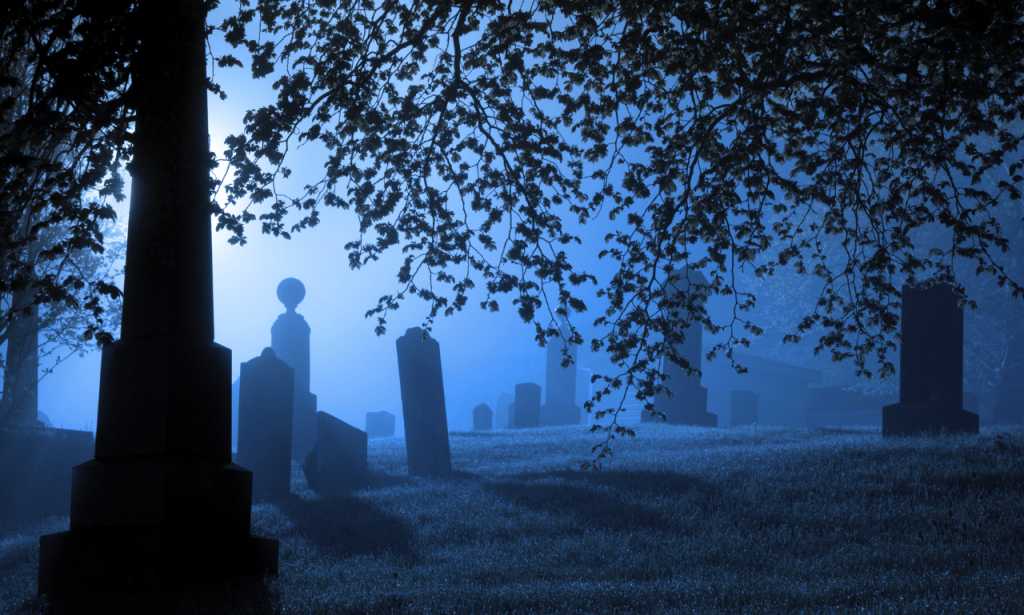
How do you know when it’s time to let an idea die?
I have a folder on my laptop called “Random Ideas.” I should give it a more descriptive name, something like “The Story Graveyard” or maybe “The Palace of Regretful Imaginings.” But it’s exactly what it sounds like – a virtual storage facility for 40-plus years’ worth of scribblings that never became anything. It’s filled with snippets of dialogue, first lines of poems, vague plot ideas, world-building notes, lists of words or character names.
I keep adding things to this Random Ideas repository. For instance, if I write something in response to a prompt, I’ll hold on to it, thinking I can turn it into a good story…only to read it again a year later and cringe. Pieces like that get sent off to fester with the other once-promising and now-neglected Random Ideas.
My Random Ideas aren’t just stored in bits and bytes. I have plenty of actual file folders, filled to bursting with notes jotted down on whatever piece of paper was handy. Recently, I found a collection of poems I had started writing when I was 14 years old. They were typewritten on onionskin paper as soft as a moth’s wing. It’s a miracle they survived this long. I can’t bear to throw them away, but I don’t want to re-read what my angsty teenage self considered poetry, so I just tossed the bunch into a drawer where they will rest for another decade.
What if those messy piles of paper and disorganized Word documents are gumming up the whole creative process, making it harder for me to focus on stories yet to come? Part of me is tempted to purge them all and start fresh, to make mental and physical space for new ideas.
I suppose there’s some truth to that idea of creative clutter, and value in clearing out the junk. But I like to think of my Random Ideas as a back-up plan – insurance for a future me who doesn’t have anything to write about. But how reasonable is that fear? Honestly, I’ve abandoned more ideas than I’d ever be able to turn into finished pieces if I lived several lifetimes. And more ideas pop up every day. That fear of running out of ideas isn’t exactly defensible. As Bill Moyers says, “You must never think that your most recent idea is your best or your last. You must be willing to keep searching your imagination and intuition for new versions of that idea.”
Another aspect to my hoarding tendencies is the spectre of unfulfilled potential. I am reminded of a scene in the Bertolucci film Stealing Beauty (1996) where Jeremy Irons’ character is frantically searching for something he had written on a scrap of paper. He says he wants to find it because it’s the best thing he’s ever written, and that of course he would think that, because he can’t find it. What if one of my abandoned ideas is a diamond in the rough, and has the potential to be a truly great story? What if that hypothetical story is the best thing I’ve (n)ever written? That’s an argument for hanging on to every last one of those ideas, right? Just in case.
On the practical side, it costs me nothing to stockpile my Random Ideas. Sure, they take up storage space in my office, but there are no out-of-pocket costs, no fire hazard, no accounting system I need to track them with. Ideas don’t go bad. Even if none of them become a finished piece, I see no harm in keeping the whole lot safely stashed away.
Truthfully, I believe each old idea, each neglected string of words, has its own intrinsic value. Not just as a stepping-stone to a story that’s deeper, more polished, more lyrical, more submission-worthy. But each one, in its own raw and unhinged way, represents the writer I was at that moment in time, and the way I encountered or observed the world. I want to be gentle with that little creative soul, and honour what she imagined.
So, I will continue to add to my Random Ideas warehouse, and let narrative bones gather dust in the Story Graveyard.
I may yet use them to conjure new life.
Looking for more weekly-ish writing inspiration? Subscribe to my newsletter, Petits écrits / Tiny writings, here.
 Maria Hypponen